Blog
How I Applied SEO Best Practices Using Semrush
A structured checklist from foundational setup to AI-driven search visibility.
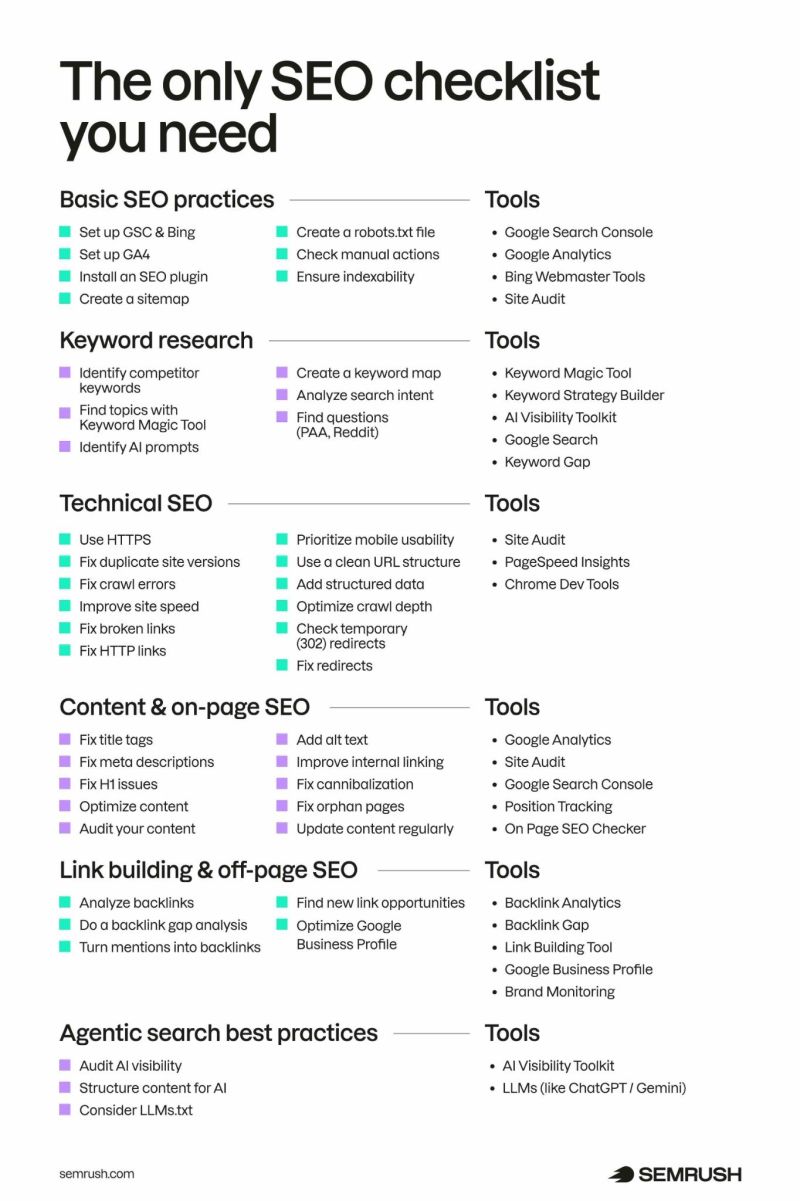
When I set out to improve search performance on this project, I didn't want to rely on guesswork. Instead, I followed a structured checklist covering everything from foundational setup to modern AI-driven search visibility — and used Semrush as my toolkit every step of the way.
The Approach
I broke the work into six focus areas:
- Basic SEO practices — Getting the fundamentals right first: setting up Google Search Console and Bing Webmaster Tools, installing GA4, creating a sitemap and robots.txt file, and confirming the site was fully indexable.
- Keyword research — Using Semrush's Keyword Magic Tool and Keyword Gap to identify competitor keywords, uncover search intent, and build out a keyword map that actually reflects how people search.
- Technical SEO — Running Site Audit and PageSpeed Insights to catch crawl errors, broken links, duplicate site versions, and mobile usability issues, while cleaning up URL structure and redirects.
- Content & on-page SEO — Auditing title tags, meta descriptions, and H1s, fixing keyword cannibalization and orphan pages, and improving internal linking with help from the On Page SEO Checker.
- Link building & off-page SEO — Analyzing the existing backlink profile, running a backlink gap analysis against competitors, and turning brand mentions into real backlinks.
- Agentic search best practices — The newest layer: auditing AI visibility, structuring content so it's readable by LLMs like ChatGPT and Gemini, and considering an llms.txt file for the site.
Why This Matters
Search is no longer just about ranking on Google — it's about being discoverable by both traditional search engines and the AI assistants people increasingly use to find information. Working through this checklist end-to-end with Semrush gave me a repeatable process I can apply to future projects, and a much clearer picture of how technical health, content quality, and off-page signals all work together.